HMX Zone Website - Full-Stack Commercial Site Built End-to-End
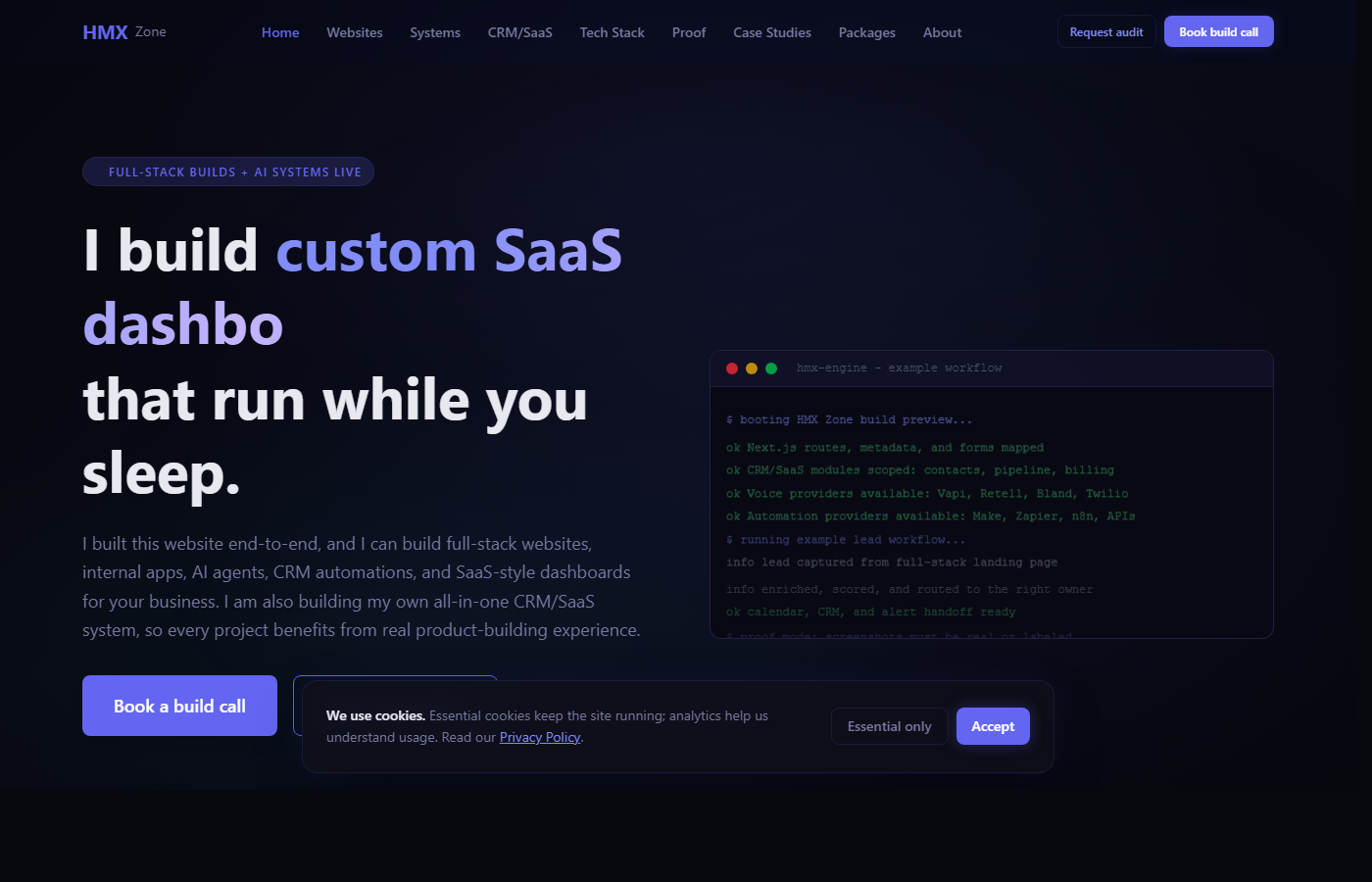
This website is itself a case study: a commercial HMX Zone site with route-based pages, package data, reviews, lead intake, SEO metadata, case-study routing, and a separate CRM/SaaS product waitlist.
1
full-stack website built end-to-end as proof of capability
17
service packages surfaced as concrete buying paths
20+
providers and platforms represented across the stack
100%
owned build: frontend, routing, content, forms, and deployment path
Why I Built It
HMX needed a first usable commercial website that could clearly sell websites, tool-based workflows, AI agents, packages, reviews, proof, and intake in one live system.
What I Built
Haroon built the route architecture, reusable section system, package surface, reviews page, Build Proof route, tracked get-started intake, CRM/SaaS waitlist, sitemap/metadata setup, and deployment-ready Next.js app structure.
What It Proves
The site itself is a working HMX-built surface: routes, navigation, package data, reviews, intake, waitlist, metadata, and conversion paths.
Problem
The public site needed to prove the offer through a real surface: custom website execution, package paths, lead intake, Build Proof, reviews, case studies, systems, content, SEO, and backend-ready structure.
System Haroon built
Haroon built the route architecture, reusable section system, package surface, reviews page, Build Proof route, tracked get-started intake, CRM/SaaS waitlist, sitemap/metadata setup, and deployment-ready Next.js app structure.
High-level workflow
- 01Visitor reads offer, systems, Build Proof, packages, reviews, or technical report
- 02Tracked CTA passes source, package, system, proof, case-study, and UTM context into /get-started
- 03Validated intake stores private scoring, service fit, tracking metadata, and internal notes
- 04Successful intake routes the lead to booking while preserving proof-first context
Operational improvements
Primary CTA moved from booking-first to context-first intake
Packages, systems, reviews, Build Proof, and case studies now share reusable typed data
Legacy /pricing and /contact paths redirect without breaking old links
Public proof points to live HMX routes, package systems, intake flow, reviews, waitlist, and shared navigation
What can break
- Missing environment variables can block live Supabase or email writes
- Future route growth can create stale labels if nav, sitemap, and metadata are not kept aligned
- Route growth can create stale sitemap, nav, or metadata entries
Fallback / prevention
- Server action keeps email failures non-blocking after database insert
- Build Proof uses live route cards instead of a screenshot gallery
- Route smoke, typecheck, lint, build, and file-line checks are used as verifiers
Data needed
- Lead intake fields and UTM/source context
- Live route URLs and page-level proof context
- Package/system identifiers for routing and follow-up
- Environment variables for Supabase, Resend, Upstash, Turnstile, and Sentry
Tools used
Proof Manifest
Privacy: No private client data is used for this case study. Captured at: 2026-04-30.
Before / After
Before
The offer was positioned too narrowly and did not clearly sell full-stack websites, tool-based workflows, AI agents, packages, reviews, and product waitlist paths.
After
The site now presents full-stack websites, AI agents, CRM workflows inside existing tools, Build Proof, case studies, reviews, packages, resources, and intake routes in one production Next.js app.
screenshot: Visual proof uses the public HMX Zone website because it is the owned system being sold and maintained.
Sensitive details removed
The public case uses HMX-owned website proof and live route context.
Related paths
This site is not just a page. It is the commercial system behind the HMX offer.
Want proof this concrete for your own system?
Start with a build call or ask for a system audit so the proof plan is clear before implementation.